

Blog · November 2, 2026 | By Monasri Kakde, Technical Writer @ Musk Deer
MERN Stack vs WordPress: Which Is Actually Right for Your Business in 2026?
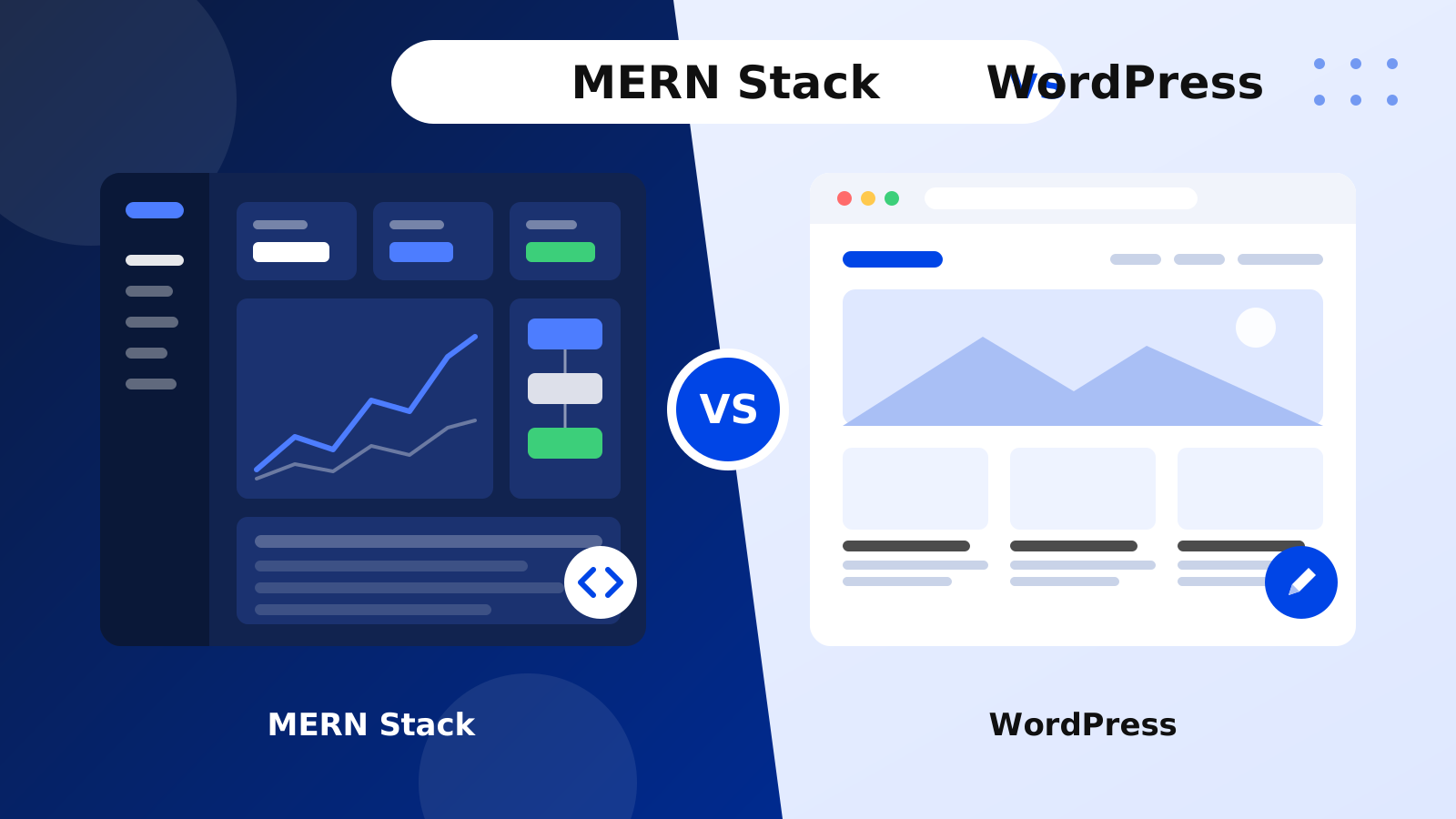
Choosing the right technology for a business website affects development costs, launch timelines, maintenance and future growth. For businesses comparing a content management system (CMS) with custom application development, the choice often comes down to WordPress and MERN Stack.
However, these technologies serve different purposes. WordPress provides an established platform for managing website content, while MERN Stack enables developers to build custom web applications. This blog will help you understand the right choice depending on your business objectives, functionality and long-term requirements.
The Real Difference: Content Website vs Custom Application
WordPress is a content management system that enables businesses to create, publish and manage website content. MERN Stack combines MongoDB, Express.js, React and Node.js to support custom application development.
Key differences include:
- WordPress: Suitable for corporate websites, blogs, content platforms and many standard ecommerce stores.
- MERN Stack: Suitable for applications requiring custom workflows, interactive dashboards, user accounts and specialised business logic.
- Content management: WordPress includes publishing tools, whereas a MERN application may require a separate or custom-built CMS.
- Development flexibility: WordPress supports themes, plugins and custom development. MERN provides greater architectural control for application-specific functionality.
The main distinction is whether a business needs to manage and present information or deliver a customised digital product.
When WordPress Is the Better Choice
WordPress is a practical option for businesses prioritising content management, straightforward functionality and efficient development.
Consider WordPress for these requirements:
- Corporate websites: Present services, company information, case studies and contact details.
- Blogs and content platforms: Allow marketing teams to publish and update articles without relying on developers for every change.
- Standard ecommerce: WooCommerce provides an established, open-source ecommerce platform built on WordPress.
- SEO management: Support content optimisation through appropriate plugins and built-in publishing capabilities.
- Faster launches: Use established themes and plugins instead of developing every component from scratch.
WordPress's adoption demonstrates its established position in website development. According to W3Techs, on 29 October 2026, WordPress powered 39.5% of all websites and accounted for 58.3% of websites with a known CMS. These figures measure adoption, not which technology is best for a particular project.
Extensive customisation can increase development and maintenance costs, so businesses should assess their functional requirements before selecting a plugin-based approach.
When MERN Stack Is the Better Choice
MERN Stack is worth considering when a website must operate as a customised application rather than primarily serve as a content platform.
It is particularly suitable for:
- Custom business logic: Develop specialised calculations, approval processes, permissions and complex workflows.
- SaaS products: Build user accounts, dashboards, subscription functionality and personalised experiences.
- Interactive applications: Create dynamic interfaces and real-time features where required.
- Complex integrations: Connect applications with APIs, external services and internal business systems.
- Product-specific development: Design application architecture around current requirements and future enhancements.
MERN Stack does not automatically guarantee better performance or scalability. These depend on architecture, implementation, infrastructure and maintenance. WordPress can also support high-traffic websites when properly configured.
MERN's principal advantage is its flexibility when developing application-specific functionality.
MERN Stack vs WordPress: 2026 Cost and Timeline Comparison
Costs and timelines depend on project scope, design complexity, integrations and maintenance requirements. The following table provides a general comparison rather than fixed estimates.
| Factor | WordPress | MERN Stack |
|---|---|---|
| Initial cost | Generally lower for standard websites | Generally higher for custom applications |
| Timeline | Often shorter for content-focused sites | Depends on application complexity |
| Content management | Built-in publishing tools | May require a separate CMS |
| Custom functionality | Plugins and custom development | Application-specific development |
| Ecommerce | WooCommerce supports standard requirements | Custom workflows can be developed |
| Maintenance | CMS, theme and plugin updates | Code, dependencies and infrastructure |
| Scalability | Supports growth with appropriate optimisation | Architecture tailored to application needs |
| Best suited for | Corporate sites, blogs and standard stores | SaaS products, portals and complex applications |
A highly customised WordPress website may cost more than a simple MERN application. Conversely, a feature-rich MERN product may require substantially more investment than a standard business website.
Compare total ownership costs, including hosting, maintenance, security, third-party services and future enhancements.
Which Technology Should Your Business Choose?
The decision should reflect business objectives, functional requirements and long-term plans.
- Choose WordPress for content publishing, service presentation, lead generation and standard ecommerce.
- Choose MERN Stack for custom workflows, complex interactions and application-specific functionality.
- Consider both when your digital ecosystem requires content management alongside a specialised application.
A business can use different technologies for different parts of its digital ecosystem when that approach meets its requirements.
Conclusion
Choosing between MERN Stack and WordPress is not about deciding which technology is better but understanding which one fits your business requirements. WordPress offers a practical solution for content-driven websites, blogs and standard ecommerce stores, while MERN Stack provides the flexibility to build customised applications with specialised features and workflows. Both can support business growth when planned, developed and maintained appropriately. Factors such as functionality, budget, development time, maintenance and future requirements should guide the decision. Ultimately, the right technology is the one that meets your current objectives while providing room for your business to evolve.
At Musk Deer, we help businesses assess their website and software development needs before selecting a technology. Contact our team for a free consultation to discuss your objectives, budget and the most suitable approach for your project.
FAQs
Is MERN Stack better than WordPress for business websites?
MERN Stack suits custom applications with specialised functionality, while WordPress is often more practical for corporate websites, blogs and standard ecommerce stores. The right choice depends on your requirements.
Can WordPress support a growing business?
Yes. WordPress can support growing businesses with appropriate hosting, optimisation, security and maintenance. More complex application requirements may justify a different architecture.
Should a startup choose MERN Stack or WordPress in 2026?
WordPress suits startups that need a marketing website, while MERN Stack may be better for software products requiring custom workflows, dashboards and application functionality.
Which is more cost-effective: MERN Stack or WordPress?
WordPress is generally more cost-effective for standard websites. MERN Stack may require greater initial investment when extensive custom application functionality is needed.
Can WordPress and MERN Stack be used together?
Yes. A business can use WordPress for content management and a MERN application for specialised functionality, provided the integration is designed to meet its technical requirements.